
6 min
Mindset & Strategy
Strategy Meets Speed
As a manager, I always had brilliant strategies. What drives me now: turning them into working prototypes myself – in one evening instead of ten weeks. That's my new superpower.
10 March 2026Read
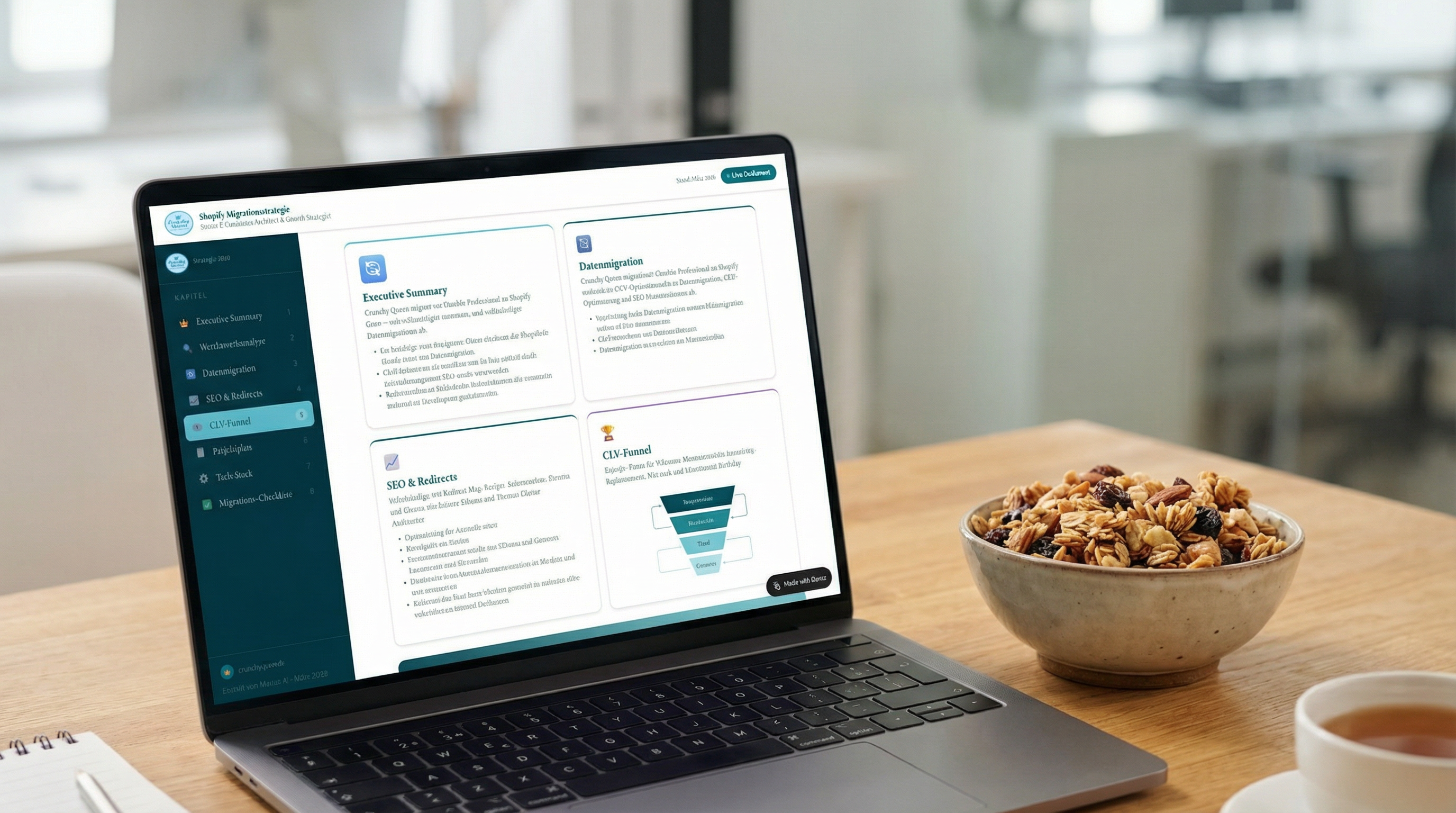
Migration strategy, project planning and first implementation steps – how I set up the complete replatforming of Crunchy Queen with Manus AI.
Philipp Kendzior
Head of Data, Continental Europe
There are projects you keep putting off. Not because you don't know they're necessary. But because the complexity is so daunting that you don't know where to start.
Migrating from Gambio Professional to Shopify Grow was one of those projects.
Crunchy Queen has been running on Gambio for over a decade. The system has served us well – but the world of e-commerce has moved on. Shopify today offers an ecosystem that brings decisive advantages for a growth-oriented food brand like Crunchy Queen: better app integrations, a superior checkout experience, native subscription models for loyal customers and – particularly relevant for me as a data head – significantly better CLV optimisation capabilities through Klaviyo flows.
The knowledge that we needed to migrate had been there for a while. What was missing: a clear plan. And the time to develop one.
Then I asked Manus AI to structure the project for me.
Anyone who has ever migrated an e-commerce platform – or watched others do it – knows the three classic risks:
Data loss. Products, customer data, order history, reviews, blog content – everything built up over years must be transferred completely and correctly. A single error can destroy customer data that cannot be recovered.
SEO collapse. A migration without a clean 301 redirect strategy is SEO suicide. URL structures change, pages disappear, Google loses track – and organic traffic collapses. For a brand that has built SEO authority over years, this is an existential risk.
Operational disruption. A food brand cannot afford to be offline for days. Customers who want to place an order and encounter an error page don't come back.
These three risks are why many businesses keep putting migrations off – or outsource them to expensive agencies that then take months and write six-figure invoices.
With Manus AI, we chose a different path.
The full project title is: From Gambio Professional to Shopify Grow – 13 Weeks · Zero Data Loss · CLV Maximisation.
These are not marketing promises. These are the three guardrails I gave Manus AI as requirements – and that structure the entire migration project.
13 weeks is the timeframe we've set ourselves. Not because it couldn't be done faster – but because we want to maintain live operations in parallel and test every step carefully. 13 weeks means: no rush job, but no endless procrastination either.
Zero Data Loss is the non-negotiable goal. Every product, every customer, every order, every review, every blog article – everything gets migrated. No compromise.
CLV Maximisation is the strategic lever that turns this migration from a mere platform switch into a growth project. Shopify + Klaviyo allows us to reach customer segments in a way that simply wasn't possible with Gambio: automated welcome flows, win-back campaigns, replenishment reminders for loyal customers, birthday flows. That is the real reason we're migrating.
This is where it gets concrete – and this is the part that impressed me most.
I asked Manus AI in a single, structured prompt run to plan the complete migration project. The result was a complete Shopify Migration Strategy Document with eight chapters:
The document is not just a plan. It is a living working instrument.
We are now in the first weeks of implementation. The strategy is set, the structure is clear, and we are working through the plan chapter by chapter. Manus AI is not just the planner here, but also the implementer: every work package described in the document is something I can tackle directly with Manus – from technical setup to Klaviyo flow configuration.
That is the difference from a classic agency project: planning and implementation are in one pair of hands. No handovers, no misunderstandings, no delays from alignment loops.
In my career, I have accompanied many migration projects – as a consultant, as a manager, as a decision-maker. And I know the classic process: requirements workshops, specification document, tender, agency selection, kickoff, project plan, status meetings, delays, change requests.
What Manus AI produced in one evening would have taken weeks in that classic process and cost a five-figure sum – just for the conceptual phase.
But that's not the real point.
The real point is: I now have a document I understand. One I co-created myself. One that speaks my language and reflects my priorities. Not an agency deliverable that ends up in a drawer. But a living plan I use every day.
That is the difference between a strategist waiting for implementation – and a maker who implements themselves.
I will document this project publicly. Not as a success story in hindsight – but in real time. With the hurdles, the learnings and the moments when the plan meets reality.
Because that is the real value of this blog: not the polished case studies, but the honest look at what actually happens when a manager builds with AI.
Are you currently in a similar project? Write to me – I'm curious to hear which migration projects are keeping you busy right now.
Did you enjoy this post?
Connect on LinkedIn and join the conversation.
Keep Reading
As a manager, I always had brilliant strategies. What drives me now: turning them into working prototypes myself – in one evening instead of ten weeks. That's my new superpower.
An established food brand, over 10 years of customer data, AI expert bots and a dashboard that would cost hundreds of thousands in a corporation. Built in my spare time. This is the story.

A BMW i4 that never arrived. A personal frustration. And a niche site with 399+ car models, daily crawls and SEO dominance – built in my spare time with Manus AI.